Notary Automation & LegalTech: Digital Transformation, E-Signatures, and Workflow Automation for Notary Firms

By Softaki Team in Automation & AI
September 24, 2026
The Turning Point for the Notary Sector: From Paper-Heavy Protocols to Smart Digital Notary Offices
Historically, the notary institution has served as a cornerstone of legal certainty, commercial trust, and institutional stability in civil law jurisdictions worldwide. However, the operational framework that has governed notary practices for the past century is facing an unprecedented structural crisis. The exponential surge in contractual volume, client expectations of immediate turnaround, and the escalating sophistication of identity theft and synthetic identity fraud have exposed the fatal flaws of relying exclusively on physical paper files, wet signatures, and manual rubber stamps.
Traditionally, processing a public deed for a real estate conveyance, incorporating a commercial entity, or executing a durable power of attorney takes between four and seven business days of exhausting manual workflow. During this timeframe, a single document passes through numerous hands: intake clerks retyping identity documents, paralegals drafting clauses in fragmented word processors, administrative staff archiving hardcopy drafts, and the head notary inspecting hundreds of physical pages daily. This manual assembly line inflates operational overhead by up to 45% while introducing critical human errors in tax calculations, dates, and party identification data.
In response to this pressing challenge, notary workflow automation driven by LegalTech and modern microservice architectures has emerged as the definitive solution. Digital transformation in the notary office is not simply scanning PDFs or sending draft agreements over email. It represents an end-to-end reengineering of notarial operations through automated biometric verification, algorithmic document generation, official registry API connectivity, and qualified digital signatures with undisputed legal validity. At Softaki, we design state-of-the-art notary automation platforms that condense weeks of procedural friction into seamless workflows completed in under 45 minutes, safeguarding the public trust with institutional-grade cryptographic security.
The 4 Major Operational Bottlenecks in Traditional Notary Management
To fully grasp the transformative impact of enterprise LegalTech on a notary practice, it is essential to diagnose the systemic inefficiencies that compromise profitability and reputation in firms that remain tied to legacy practices:
1. Redundant Data Entry and Transposition Errors: Whenever an appearing party visits a notary office, their identification details, marital status, corporate authority, and address are manually entered into the intake register, retyped by the drafting attorney, transcribed again into the official protocol book, and copied once more onto the public deed copies. Each manual transcription introduces an inherent risk of clerical errors that frequently triggers costly objections or rejections from national land and corporate registries.
2. Vulnerability to Forgery and Impersonation Schemes: Despite a notary's best visual inspection, human examination of identity cards, embossed seals, or ink signatures is structurally inadequate against criminal syndicates specializing in real estate fraud and forged credentials. Without automated, real-time biometric verification connected to national civil identity databases, a notary practice operates under constant civil and professional liability risks.
3. Fragmented Tracking and Dossier Chaos: In a mid-sized notary firm managing over 800 complex acts per month, tracking which desk holds a specific file, whether municipal property taxes were paid, or if a secondary party has signed becomes an operational quagmire. Constant phone calls from anxious clients inquiring about the status of their transactions overwhelm reception lines and consume hundreds of valuable billable hours.
4. Astronomical Physical Archiving Costs and Paper Vulnerability: Archiving bound physical protocol books across decades demands substantial commercial real estate equipped with fire-suppression systems, climate-controlled environments to prevent moisture damage, and dedicated archiving personnel. Migrating to an electronic protocol and cloud-indexed document repository eliminates up to 80% of these recurring overhead expenses.
Comprehensive Notary Software Architecture: Softaki's 5 Core Modules
At Softaki, we build enterprise legal ecosystems engineered to augment the notary's professional judgment rather than attempt to automate away legal discretion. Our modular software suite consists of five interoperable engines:
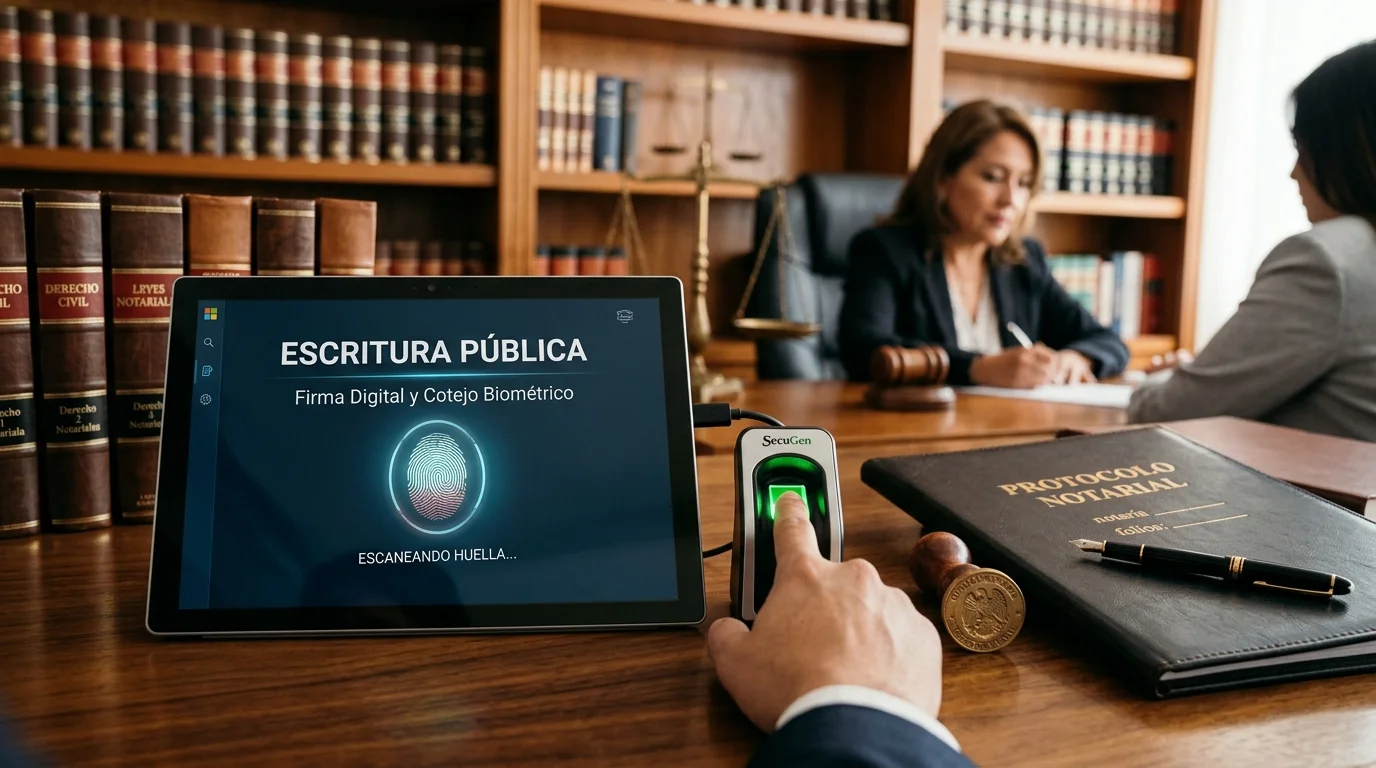
A. Digital Intake & Advanced Biometric Identity Verification: From the moment an individual checks into the office or accesses the secure online intake portal, certified optical character recognition (OCR) scanners extract government ID details while biometric facial or fingerprint sensors run certified liveness detection tests. The system communicates instantaneously via encrypted APIs with national identification databases (civil registries, voter rolls) and anti-money laundering (AML/PEP/OFAC) sanction screening lists, issuing an immutable compliance audit certificate before document generation begins.
B. Intelligent Document Generation & Parametric Legal Templates: Discard outdated, risk-prone Word documents. Our platform leverages parametric templates with conditional legal logic. The drafting attorney simply selects the notarial instrument type (e.g., General Power of Attorney with Real Estate Alienation Powers) and the software guides them through structured inputs. Based on responses, the engine automatically populates statutory clauses, validates the marital status of grantors, inserts mandatory anti-bribery covenants, and computes notarial and registration fees dynamically.
C. Centralized Electronic Protocol & Real-Time Kanban Workflow: Each notarial file receives a universally unique identifier (UUID) and a tamper-proof QR tracking code. The notary team monitors a visual Kanban board reflecting the exact milestone of every case: Under Review, Pending Biometrics, Awaiting Notary Signature, Filed with Registry, or Finalized. Clients receive automated SMS, WhatsApp, and email updates upon reaching key milestones, eliminating over 90% of status check phone calls.
D. Qualified Digital Signatures & Cryptographic RFC 3161 Timestamping: We integrate accredited digital certificate providers (eIDAS, INDECOPI compliant) with Hardware Security Modules (HSMs) and cryptographic tokens. Notaries can sign batches of hundreds of public instruments, certified copies, and deed extracts in seconds, embedding cryptographic timestamps that guarantee long-term data integrity and non-repudiation.
E. Inter-Institutional Connectivity with Public Registries and Banking Gateways: Softaki's architecture bridges directly with electronic public land and commercial registries through secure REST endpoints. Digital title filings, fee disbursements, and electronic escrow payments occur inside a single unified dashboard, streamlining closing procedures.
Comparative Analysis: Traditional Notary Practice vs. LegalTech-Powered Smart Office
The following comparative matrix demonstrates the qualitative leap in turnaround speed, legal security, and client satisfaction achieved when deploying Softaki's notary automation platform:
• Power of Attorney Issuance: Traditional takes 4 to 6 hours (prolonged waiting room congestion); Automated takes 15 to 20 minutes (assisted drafting and instant biometric match).
• Complex Commercial Public Deed: Traditional takes 4 to 8 business days; Automated takes 24 to 48 hours with automated pre-qualification of prerequisites.
• Identity Fraud Mitigation: Traditional relies on manual visual comparison of physical ID cards and ink thumbprints (highly susceptible to forgery); Automated features AI-backed liveness checks and sub-second government database verification.
• Registry Rejection Rate Due to Typographical Flaws: Traditional averages 8% to 14% of submitted titles requiring rectifying deeds; Automated drops below 0.5% through algorithmic cross-validation.
• Client Status Inquiries: Traditional relies on frequent phone calls and reception bottlenecks; Automated delivers 24/7 client portal self-service and proactive WhatsApp notifications.
• Historical Record Retrieval: Traditional requires manual searching through physical warehouse boxes prone to environmental decay; Automated provides instant semantic search across millions of historical records with AES-256 encrypted cloud backup.
Enterprise-Grade Security Standards and Regulatory Compliance
A frequent concern among legal professionals evaluating digital transformation is data privacy, cloud sovereignty, and jurisdictional statutory compliance. How does digital evidence stand up in formal litigation? How is client confidentiality protected?
Modern electronic signature legislation globally (such as the EU eIDAS regulation, US ESIGN Act, and Latin American digital certification statutes) unequivocally affirms that qualified electronic signatures hold equivalent legal force and evidential weight to handwritten signatures. In fact, cryptographic signatures provide superior evidentiary proof because any post-execution tampering invalidates the cryptographic hash instantly.
Softaki designs all LegalTech platforms under a strict Zero-Trust cybersecurity architecture. Data in transit is protected via TLS 1.3 with Extended Validation SSL, and data at rest is encrypted using military-grade AES-256. Crucially, we enforce immutable audit logging: every access, draft revision, approval, and signature logs the IP address, precise millisecond timestamp, hardware identifier, and digital certificate fingerprint, providing notaries with ironclad forensic evidence against any future legal challenge.
Softaki's 4-Phase Agile Implementation Roadmap for Notary Firms
We understand that an active notary practice cannot halt client services to install new software. Urgent real estate closings and daily transactions cannot be paused. That is why Softaki employs a phased rollout methodology ensuring zero downtime:
Phase 1: Operational Diagnostic & Legal Template Modeling (Weeks 1-2): Our legal engineers examine your firm's highest-volume acts. We parameterize your deed templates, powers of attorney, and certified formats into dynamic templates that rigorously preserve your firm's distinct drafting style.
Phase 2: Hardware Integration & API Connectors (Weeks 3-4): We configure biometric scanners, cryptographic signature tokens, and direct API bridges to civil identity authorities and payment providers. We securely migrate your legacy client registries and historical dossiers.
Phase 3: Role-Based Hands-On Training & Sandbox Testing (Weeks 5-6): We conduct role-specific training sessions for reception staff, paralegals, office administrators, and notaries. Practical simulation workflows ensure your team achieves complete proficiency prior to public launch.
Phase 4: Production Go-Live & 24/7 Dedicated Engineering Support (Week 7 Onward): Full production rollout with on-site technical accompaniment and continuous telemetry monitoring. We proactively adjust workflows based on live volume and team feedback.
The measurable business return on investment (ROI) is immediate: notary firms achieve a 60% reduction in paper and printing costs, an 85% increase in throughput capacity per associate, and a client satisfaction rating surpassing 98%, firmly establishing the practice as a premier digital leader in its jurisdiction.
Does implementing notary automation require replacing our existing office computers?

What is the legal validity of the digital signatures and biometric verifications used?
How does the platform prevent identity theft and fraudulent impersonation?
How can our notary practice schedule an initial diagnostic and demonstration with Softaki?
Ready to Modernize Your Notary Firm with Softaki?
At Softaki, we guide notary practices through every step of their digital evolution: intelligent legal deed templates, official civil registry integrations, and certified electronic signatures backed by full non-repudiation.
